


The Way of Spirit Harmony
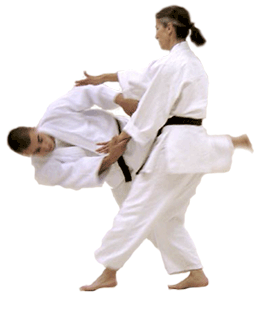
Aikido is an almost purely defensive martial art, Aikido emphasizes evasion of attack and blending with the attacker's momentum to control the force and finally neutralize the attack. Such skill requires balance, flexibility, timing and endurance. Aikido training exercises are dynamic and stimulating and significantly improve physical fitness.
 During training sessions, Tomiki Aikido instructor
Dr.
Ed Mink often states that "Aikido is of the mind". As
Aikido students practice new movements and techniques there is much to
occupy the mind in terms of angles of entering the attack, and how much
power to apply to neutralize the attacker. Perhaps the greatest mental
challenge for the student is to consistently apply the principles of
blending and flowing with the attacker's momentum as opposed to using
pure muscular strength to physically overwhelm the opponent.
Additionally, consistent adherence to a rigorous training schedule
results in a sense of mental self-discipline.
During training sessions, Tomiki Aikido instructor
Dr.
Ed Mink often states that "Aikido is of the mind". As
Aikido students practice new movements and techniques there is much to
occupy the mind in terms of angles of entering the attack, and how much
power to apply to neutralize the attacker. Perhaps the greatest mental
challenge for the student is to consistently apply the principles of
blending and flowing with the attacker's momentum as opposed to using
pure muscular strength to physically overwhelm the opponent.
Additionally, consistent adherence to a rigorous training schedule
results in a sense of mental self-discipline.
Relating to the emotional and social dimensions of health, the Aikido practitioner may experience a number of significant benefits. As students gain technical proficiency through training and practice they begin to feel more empowered and internalize a greater sense of personal control. Self-confidence in other areas of their lives improves. The "elegant power" of their body movements and the attendant uplifting emotional experience is difficult to describe, but no less real and desirable. True aikido students continually strive to perfect the powerfully elegant and artistic techniques that define the art and produce a sense of wonder and magic within the performer.
During training, students harmonize with one another as they seek to
understand and appreciate the principles of blend and flowing. Aikido
training, while dynamic and intense is also enjoyable and socially
interactive. The very nature of the art fosters a sense of relationship
and family among the practitioners. Also, the notion of blending and
flowing with a malicious assault can be applied to managing more
effectively an interpersonal conflict. Angry verbal attacks can be
neutralized in ways that may actually lead to some enhancement within
the relationship. O sensei (Great Teacher), the founder of Aikido,
instructed aikido students to pursue training in order to maximize their
potential as human beings, to unlock their internal resources and use
them for the good of society. The powerful techniques of Aikido are only
to be utilized to assist those who are unable to defend themselves. To
look out for and care for others is the true intent of the practice of
Aikido. To avoid hurting and or maiming others is the guiding principle
of aikido, otherwise we disrupt the harmony of the universe. Such is the
overwhelming message from the founder guiding the practice of this art.
It is truly a "way of spirit harmony." It truly is a pursuit
of "wonder."
and intense is also enjoyable and socially
interactive. The very nature of the art fosters a sense of relationship
and family among the practitioners. Also, the notion of blending and
flowing with a malicious assault can be applied to managing more
effectively an interpersonal conflict. Angry verbal attacks can be
neutralized in ways that may actually lead to some enhancement within
the relationship. O sensei (Great Teacher), the founder of Aikido,
instructed aikido students to pursue training in order to maximize their
potential as human beings, to unlock their internal resources and use
them for the good of society. The powerful techniques of Aikido are only
to be utilized to assist those who are unable to defend themselves. To
look out for and care for others is the true intent of the practice of
Aikido. To avoid hurting and or maiming others is the guiding principle
of aikido, otherwise we disrupt the harmony of the universe. Such is the
overwhelming message from the founder guiding the practice of this art.
It is truly a "way of spirit harmony." It truly is a pursuit
of "wonder."